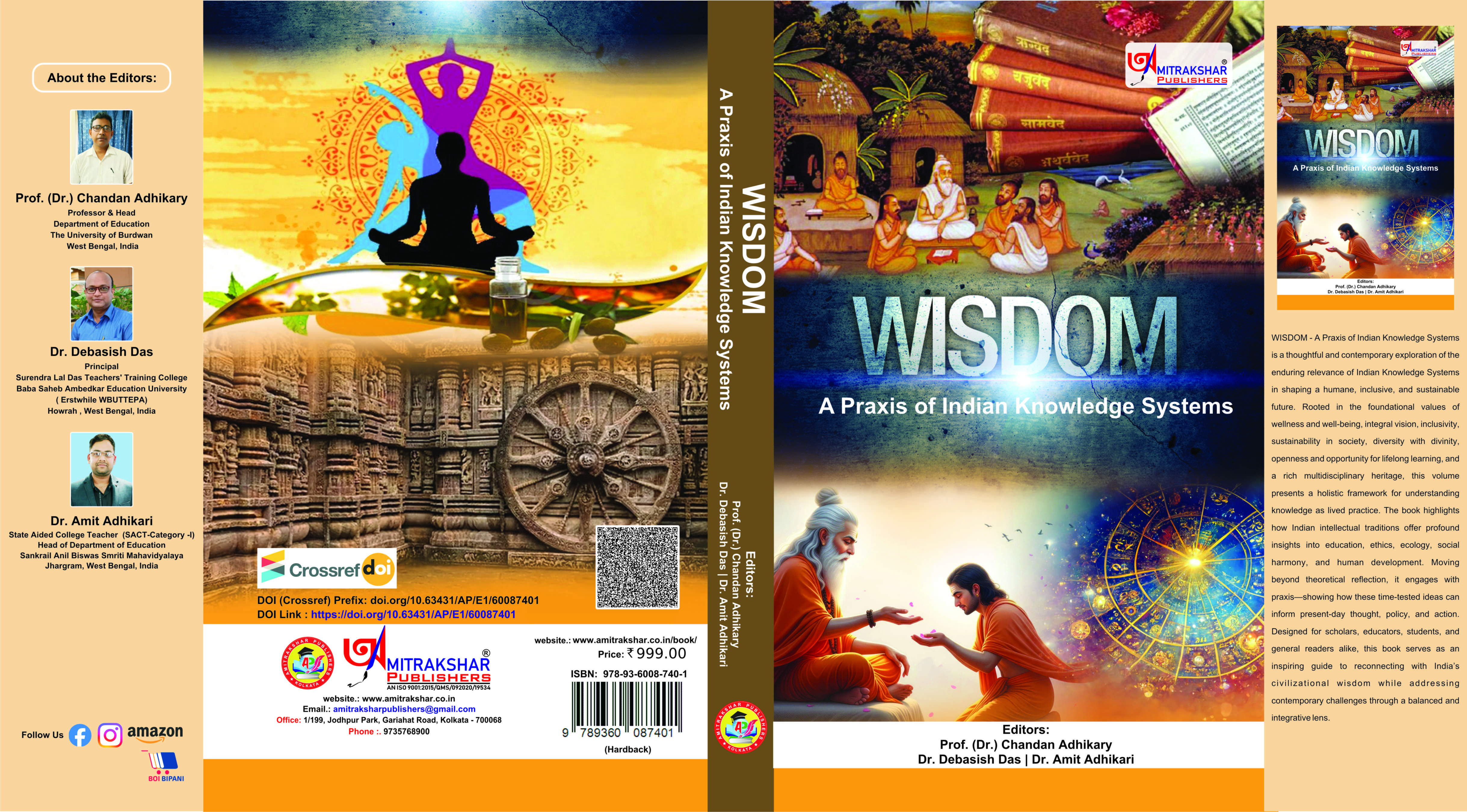
Book Title WISDOM - A Praxis of Indian Knowledge Systems | Editors: Prof. (Dr.) Chandan Adhikary | Dr. Debasish Das | Dr. Amit Adhikari
Book Title
WISDOM - A Praxis of Indian Knowledge Systems
Editors: Prof. (Dr.) Chandan Adhikary | Dr. Debasish Das | Dr. Amit Adhikari
__________________________
About the Editors
Prof. (Dr.) Chandan Adhikary
Professor & Head Department of Education , The University of Burdwan, West Bengal, India
Dr. Debasish Das
Principal , Surendra Lal Das Teachers' Training College, Howrah , West Bengal, India
Dr. Amit Adhikari
State Aided College Teacher (SACT-Category -I), Head of Department of Education, Sankrail Anil Biswas Smriti Mahavidyalaya, Jhargram, West Bengal, India
Copyright Received: By Editors©
ISBN Number : 978-93-6008-740-1 ( Hardback)
DOI (Crossref)Prefix: doi.org/10.63431/AP/E1/60087401
Link DOI (Crossref)Prefix: https://doi.org/10.63431/AP/E1/60087401
Edition -1, Rs: 999/-
First Published on: 04/03/2026
Language: Multiple languages
Published by : AMITRAKSHAR PUBLISHERS , Kolkata -700068
Website: www.amitrakshar.co.in
Website link: https://www.amitrakshar.co.in/book/
✉️ Email: amitraksharpublishers@gmail.com
Phone/ WhatsApp Number: 9735768900
Amitrakshar Publishers - Kolkata
The book is divided into twenty chapters, each contributing a unique perspective on Indian Knowledge Systems. Here is a brief overview of the contributions:
Chapter-1: WISDOM: Reimagining Education through Indian Knowledge Systems for Holistic Well-being by Prof. (Dr.) Partha Karmakar & Dr. Amit Adhikari, addresses how Indian education systems, which have traditionally prioritized holistic well-being, can be reimagined to meet the needs of today’s learners. The authors discuss how ancient Indian educational principles such as Vidyā (knowledge) and Avidyā (ignorance) can inform modern educational paradigms that promote overall development.
Chapter-2: Instantaneous Response of Surya Namaskar on Cardiorespiratory Metric in Women Yoga Practitioners by Dr. Gopa Saha Roy, Kartick Chandra Mandal, Mousumi Nath, Minakshi Malik & *Dr. Chandan Adhikaryexplores the physiological benefits of Surya Namaskar (sun salutation) and its role in enhancing physical health. The chapter presents empirical findings that demonstrate the importance of integrating yogic practices into modern wellness routines.
Chapter-3: Lifelong Learning in the Age of AI and Human-AI Collaboration by Debashmita Kundu & Madhumita Teli, delves into the intersection of artificial intelligence and lifelong learning. The authors reflect on how Indian Knowledge Systems’ emphasis on continuous education can offer insights into navigating the challenges posed by AI and the need for human-AI collaboration.
Chapter-4: Openness and Lifelong Learning in Ruskin Bond: A Romantic Perspective on Indian Knowledge Systems by Dr. Tamal Jana, examines how Indian philosophical thoughts, as portrayed in literature, can help foster openness and lifelong learning. Jana looks at the works of Ruskin Bond and other Indian authors to explore how Indian culture nurtures a holistic understanding of the self.
Chapter-5: Openness and Opportunity for Lifelong Learning in Indian Writing in English: Literature as a Pathway to Continuous Wisdom by Dr. Partha Sarathi Nandi, presents a compelling argument for the role of Indian literature in promoting lifelong learning. Dr. Nandi discusses how the nuances of Indian writing in English reflect the profound wisdom of Indian Knowledge Systems.
Chapter-6: Integrating Yogic Practices for Holistic Wellness and Well-Being in Physical Education by Mr. Amal Dutta, addresses the integration of yogic practices into modern physical education curricula. The chapter underscores the significance of Asana and Pranayama (breathing exercises) in promoting mental and physical well-being.
Chapter-7: Governance, Wellness and Well-being: Political Perspectives from Indian Knowledge Systems by Mr. Swarup Rana, looks at the relationship between governance and well-being through the lens of Indian political thought. The chapter explores ancient Indian concepts of Rajdharma (duties of the ruler) and their application in contemporary governance.
Chapter-8: The Heritage of Indian Political Thought: An Less discussed Intellectual Tradition from the Vedas to Chanakya by Trina Mitra Ghosh, delves into the intellectual tradition of Indian political thought. Ghosh traces the evolution of political ideas from the Vedic period to the era of Chanakya, showing how these ideas continue to inform modern political theory.
Chapter-9: Openness and Lifelong Learning in Indian Knowledge Systems: Implications for Democratic Citizenship by Dr. Prodip Das, emphasizes the role of Indian Knowledge Systems in shaping democratic citizenship. Dr. Das argues for the importance of education in fostering a sense of social responsibility and civic duty.
Chapter-10: Sustainability in Ancient Indian Society: Lessons from Historical Practices and Knowledge Systems by Mr. Parikshit Giri, explores how ancient Indian practices can inform modern approaches to sustainability. Giri looks at historical examples of resource management, ecological balance, and community welfare to extract valuable lessons.
Chapter-11: Integral Vision in Indian Civilization: Historical Perspectives on Inclusivity in Vedic and Post-Vedic Society by Dr. Nilendu Patra, addresses the concept of inclusivity in Indian civilization, discussing how the Vedic and post-Vedic texts promote a holistic worldview that includes all aspects of life, from spiritual to social.
Chapter-12: Ethical Foundations of Indian Knowledge Systems in the Context of Lifelong Learning by Debasmita Kar, discusses the ethical underpinnings of Indian Knowledge Systems. The chapter presents an overview of Dharma and its role in shaping moral conduct in lifelong learning.
Chapter-13: Yoga Education as Core Affective Pedagogy: A Critical Examination of Its Integration into Teacher Preparation Programmes in India by Dr. Bula Dey, explores the integration of yoga education into teacher preparation programs. The chapter looks at how yoga can be used to promote emotional intelligence and holistic pedagogy.
Chapter-14: Botanical Knowledge in Indian Traditions: Indigenous Wisdom for Wellness, Healing, and Sustainability by Mr. Debasish Maity, explores the rich botanical knowledge embedded in Indian traditions. Maity discusses how this indigenous wisdom can contribute to modern sustainability and wellness practices.
Chapter-15: Openness and Opportunity for Lifelong Learning in Indian Knowledge Systems (IKS) by Dr. Gobinda Gopal Jana, emphasizes the need for openness in the educational systems influenced by Indian Knowledge Systems. Dr. Jana argues for a more inclusive approach to education that supports continuous learning.
Chapter-16: Inclusive Education and Integral Vision in Indian Knowledge Systems: Pathways to Holistic Lifelong Learning by Dr. Anup Sasmal, explores the connection between inclusive education and lifelong learning. Dr. Sasmal argues that Indian Knowledge Systems offer pathways to a more equitable and comprehensive educational framework.
Chapter-17: Sustainability in Society through Indian Knowledge Systems: Geographical Perspectives on Ecology and Community Wisdom by Mr. Tanmoy Ghosh, examines how Indian Knowledge Systems address sustainability through geographical perspectives. Ghosh looks at ecological practices rooted in ancient Indian wisdom.
Chapter-18: Mathematics in Indian Knowledge Systems: Wisdom, Logic, and the Pursuit of Lifelong Learning by Dr. Shibendu Midya, discusses the role of mathematics in Indian Knowledge Systems. Dr. Midya looks at the logic and wisdom embedded in Indian mathematical practices, such as Vedic mathematics.
Chapter-19: Indian Knowledge Systems and Sustainable Society: Wisdom Traditions for Ethical Governance and Public Well-being by Mr. Keshob Barman, explores how Indian wisdom traditions inform the principles of ethical governance and public well-being, promoting sustainability in societal systems.
Chapter-20: Sustainability in Society: Lessons from Indian Knowledge Systems for Contemporary Public Policy by Dr. Chandan Mandal and Soma Mishra, concludes the book with an examination of how lessons from Indian Knowledge Systems can shape contemporary public policy, particularly in areas related to sustainability.
DOI Link : https://doi.org/10.63431/AP/E1/60087401
About Us
Amitrakshar® Publishers Kolkata
